

Quick comparison of a vintage Marshall Super Lead (1969) and a modern Diamond Amps Nitrox.
Player: Antoine Pütz
Guitar: Gibson Les Paul Standard (Custom Shop)
Tuning: drop C
Cab: Marshall 4×12 – 1960AV
Attenuator on SLP: Bad Cat Leach


Quick comparison of a vintage Marshall Super Lead (1969) and a modern Diamond Amps Nitrox.
Player: Antoine Pütz
Guitar: Gibson Les Paul Standard (Custom Shop)
Tuning: drop C
Cab: Marshall 4×12 – 1960AV
Attenuator on SLP: Bad Cat Leach

Dealers and manufacturers of musical instruments have to pay fines amounting to millions because of price fixing and price fixing agreements. According to the Bundeskartellamt, fines totalling around 21 million euros were imposed on the companies and their responsible employees. The manufacturers were charged with vertical price fixing and the dealers with horizontal price fixing in several cases.
The dealers in question are Thomann GmbH and Music Store Professional GmbH. The manufacturers, or their distribution companies, are Yamaha Music Europe GmbH, Roland Germany GmbH and Fender Musical Instruments GmbH. The proceedings were initiated in April 2018.
Manufacturers enforced minimum prices!
According to the Bundeskartellamt, there had been agreement between the manufacturers of musical instruments and the retailers to implement the manufacturers’ minimum price specifications. When Thomann and Music Store had fallen below the minimum prices, responsible employees of Yamaha, Roland and Fender had contacted the dealers several times and asked them to adjust their prices. These adjustments were then also made.
“In isolated cases, sanctions such as a delivery stop or a reduction in conditions were threatened or imposed. For some of the products, on the other hand, there was no or only sporadic enforcement or monitoring of the specified minimum prices,” the Cartel Office” said.
Thomann and Music Store had, however, also demanded that other instrument dealers comply with the minimum prices by complaining to the manufacturers. In addition, there had also been indications of price agreements between the two dealers. In 13 cases, there had been agreements on price increases for individual musical instruments or complementary products.
“For years, manufacturers and dealers of musical instruments have systematically worked to restrict price competition vis-à-vis end consumers,” explained Andreas Mundt, President of the Bundeskartellamt. “With the fines imposed, the Bundeskartellamt is sending a clear signal not only to the companies concerned but also to the entire musical instrument sector that infringements of the ban on fixed prices and price fixing will not be tolerated.”
The manufacturers and dealers had cooperated extensively with the Bundeskartellamt in clarifying the agreements – this circumstance had been taken into account when setting the fines. The proceedings were finally concluded by amicable termination.


Is there any love for Gibson basses? In my opinion Gibson basses are underrated. One of my go-to basses is a four string ES-335 bass. Put some flatwounds on it, plug it into the Ampeg B-15 and you’re time warped into the sixties. Tons of vintage low end and growly bass notes. I love the Gibson basses and apart from an occasional thunderbird I rarely see any at a gig.
In general, guitarists are very “conservative” people. Many guitarists swear by the classics: Strat’s and Tele’s, LP’s and SG’s. Bass players are less prone to stick to a particular type (or brand). Spend one day at a festival and you’ll notice guitarists with Fenders and Gibsons but the bass players are different: Fender, Rickenbacker, Zon, Fodera, Dingwall, Ibanez, Warwick, Lakland, Musicman, Sadowsky,… Hardly, if ever, you’ll see a bassist with a Gibson. Yes, Cream had an EB bass, I know…
Two years ago, I came across this Gibson EB-5 bass. Five because it’s a five string, what did you think? As many bass players I never had any attention for the modern Gibson basses but what caught my eye was the finish. The red satin finish of the swamp ash body, black hardware and the red inlays are stunning. No doubt about it, this was the bass version of my 2016 Les Paul Voodoo. I have a 2004 and a 2016 Les Paul Voodoo. It are LP Studio’s with superhot red and black zebra pickups. Real eye-catchers. This 2019 EB-5 was the Bass version of my 2016 Les Paul.


I got a good deal on it and picked it up for around €1000 (including VAT). It is a small price for such a lot of bass! I searched the internet and never came across another one like this. Yes, there was a similar instrument in France but it had a rosewood fingerboard, mine has a richlite board and blacked out hardware (Grover “elephant-ear” tuners and a black Babicz full contact bridge). The quality of the instrument surprised me and I was really stoked. It’s a player and a stay-er! A five string is not so comfortable for me, at first I used the low B as a thumb rest. Once used to it I could dig and appreciate the extra low end.

After some research I found out these basses were destined to end up in Japan. More than once Gibson did something special with their end-of-life products. Before sending them into oblivion they “reworked” the instruments for the Japanese market. I have two Gibson Les Paul London Fog’s which are actually Dark Fire LP’s stripped from their robot tuners and electronics and finished in a greenish/salmon red color… Again, for the Japanese market.


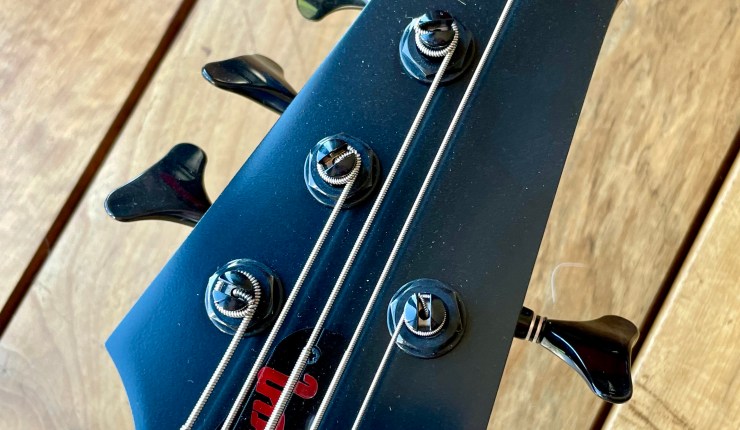
The EB-5 is a great bass. Swamp ash body, maple set neck and dual humbuckers. The electronics are passive with a black knurled volume knob for each pickup. The pups are splitable (coil tap) and you can combine and dial in to your liking. The 34” scale bass has 24 (!) frets and a fretboard radius of 21”. The wide rounded neck requires long fingers but the wide string spacing won’t disappoint slappers.
Overall, it is the look of the bass. A red satin nitro lacquer finish called “juju”, red marker dots, chrome hardware and long sleek elegant body. A well balanced instrument.
Let’s Rock!

The Gibson Les Paul Sunken Treasure is a limited run made of reclaimed wood. In 2016 it came with a natural Natural and River Green color option.

The body of the guitar is made of mahogany that came from a riverbed in Belize. It is a modern weight relief body with a carved mahogany top, creme binding around the edges.
According to Gibson these have a one-piece or two-piece body and a two-piece top. This one has a one-piece body and it is hard to see if it is a one- or two-piece top.
The neck is made of mahogany as well. It is rounded in the back and has a 22-fret fingerboard made of bulletwood on top (A very dense wood also reclaimed from the riverbed).
The guitar features `57 Classic pickups and they provide a distinct rock tone with a nice low end.
Here is a pic the River Green version:

Keep on rockin’

I wish you all a Merry Christmas and a happy New Year! Lots of love, lots of health and happiness for you and your family. 2020 was an annus horribilis for many of us but hey… the only way is UP!
What better way to close this year with a special guitar. The Oz is a Tele-style guitar by Patrick James Eggle (UK). Top and neck are made from 5000 year old bog oak. This thing is older than the pyramids. So what’s another year…?
Seasons Greetings from all of us at Château PGC. Have Fun! Keep it safe!


